
DeFi Gameverse

Building Kubernetes for a DeFi app

You're building a DeFi platform, but you have no cloud infrastructure strategy and no in-house expertise to design one. Where do you even start to build a secure, scalable system that users will trust with their assets?

DeFi Games Happy Customer

Security-first infrastructure

In DeFi, infrastructure goes beyond performance - it's about trust. Users rely on the platform with their crypto assets, making security, compliance, and reliability non-negotiable. Our client needed more than a technical build-out - they required a strategic partner who could serve as their Solution Architect, designing a multi-layered AWS environment that would meet the stringent demands.

Quick facts

GameFi Platform

iGaming infrastructure

GameFi project creating an immersive platform where users grow their crypto assets through interactive, game-like experiences, requiring enterprise-grade security and performance.

See their feedback

<1s

Game Response Time

Through architectural design and optimization on AWS, we delivered a platform with sub-one-second response times and sustained uptime, ensuring a seamless user experience even under high transaction volumes.

AWS + Kubernetes

We architected the entire infrastructure on AWS, leveraging EKS for scalability and a comprehensive security suite including WAF, Shield, Secrets Manager, and IAM to protect crypto assets.

“The best result is that our goals have been achieved. Our site response is really fast, less than one second. The cloud infrastructure works with sustained uptime.”

Harry Palteka

CEO, iGaming platform

What we did for DeFi Gameverse

Cloud architecture & provisioning automation

This project wasn't only about migrating an existing system or optimizing a legacy stack. It was a greenfield build requiring a complete architectural vision. The client needed a blueprint that could handle high-volume transactions while ensuring that every deployment was consistent, auditable, and error-free. So we started our work with:

  1. Infrastructure design from scratch: We acted as the lead Solution Architect, translating business goals into a technical blueprint. We designed the entire AWS architecture, selecting EKS for scalable container orchestration and RDS for transactional data, all within a secure network topology using private subnets to isolate sensitive components.
  2. Full infrastructure & deployment automation: To ensure rapid, safe releases, we implemented a complete automation stack. The infrastructure was provisioned entirely with Terraform, ensuring identical environments. A CI/CD pipeline using GitHub Actions automated code integration and deployment, providing a consistent and auditable path to production.
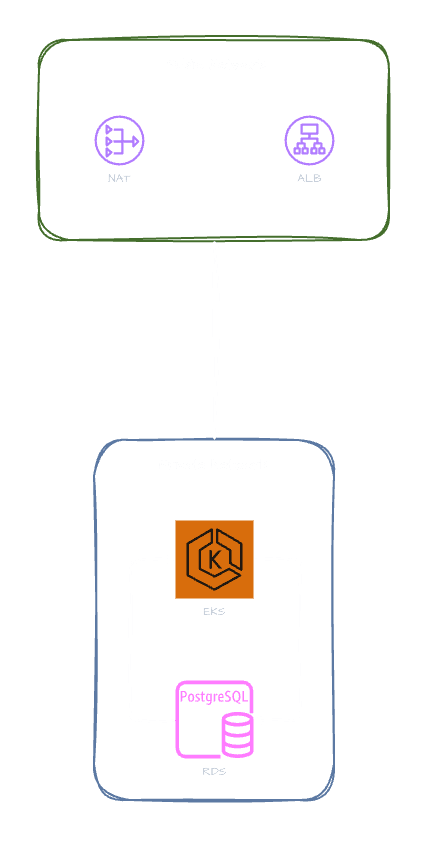

Simple AWS EKS Diagram

Defense-in-depth & full observability

In DeFi, protecting user assets requires a complex security strategy that goes beyond basic firewalls. Since people working with crypto assets trust the product, and not in the people or promises, it needs to be combined with deep observability to detect and respond to threats in real-time. So we implemented:

  1. Multi-layered security: We deployed a defense-in-depth strategy. AWS WAF and Shield provide edge protection against DDoS attacks, while Secrets Manager and KMS ensure keys and data are encrypted and secure. Strict IAM roles enforce least-privilege access, protecting assets at every level of the stack.
  2. Comprehensive observability: To maintain operational excellence, we established full observability using CloudWatch for real-time monitoring and alerting, and CloudTrail for immutable audit logging. This proactive stance allows the client to minimize costs post-launch while maintaining the sub-one-second response times required for a seamless user experience.

Solution architecture for DeFi: FAQ

We begin by acting as Solution Architect to translate your business goals into a complete technical blueprint. For a greenfield DeFi project like our client's, this meant designing the entire AWS architecture from scratch.

The process started with defining the core requirements for security, scalability, and compliance. We then designed the foundational layers, including a secure network topology, configured EKS and RDS, and created a comprehensive plan for implementation, ensuring a start with a robust and future-proof strategy.

It means security is not a single feature, but a defense-in-depth strategy that protects the platform at every level, from the public internet down to the individual data record.

For this project, the layers included:

  • Edge Protection: Using AWS WAF and Shield to block DDoS attacks and malicious web traffic before it reaches the application.
  • Access Control: Implementing strict, least-privilege IAM roles and workload identity to control who and what can access critical resources.
  • Secrets Management: Centralizing all keys, credentials, and seed words in AWS Secrets Manager to eliminate hard-coded secrets.
  • Data Encryption: Leveraging AWS KMS to ensure all sensitive data stored in services like S3 and RDS is encrypted at rest.

By building on a containerized, microservices-based architecture orchestrated by Kubernetes. This approach allows individual components of the platform to scale independently based on demand.

We deployed the core services on AWS EKS, which automatically manages resource allocation. For asynchronous processing of high-demand transactions, we integrated event-driven services like AWS Lambda and SNS/SQS, ensuring the platform remains responsive and performant even during peak usage.

Through a fully automated CI/CD pipeline that enforces consistency and minimizes human error. The goal is to make deployments frequent, reliable, and safe.

We implemented a pipeline using GitHub Actions that automates the entire process from code commit to production. The infrastructure itself is defined as code using Terraform, which ensures that every environment is provisioned identically, eliminating configuration drift and making the deployment process predictable and auditable.

Comprehensive, real-time observability across the entire stack is critical. You need to not only monitor performance but also maintain a complete audit trail for security and compliance.

Our solution involved integrating Amazon CloudWatch for deep infrastructure health monitoring and application performance metrics. We configured custom alarms to notify the team of any anomalies for rapid response.

For compliance, AWS CloudTrail was implemented to provide detailed, immutable logs of all API activity and system events, creating a robust audit trail.

Background Image

We’d love to hear from you

Ready to prepare your product for the next growth level?

Talk to our team about your needs.

Contact us